Best Golf Launch Monitors UK: Which One Suits Your Space and Budget
A launch monitor is the part of a golf simulator that does the measuring. It reads the ball, and on most models the club, then turns every shot into numbers and a ball flight on screen. Where it sits decides how much room you need, so we've picked these 13 for the space you've got as well as the money you want to spend.
Quick summary
For most UK garages and spare rooms our pick is the SkyTrak ST MAX at £1,695, because it sits beside the ball and needs no room behind you.
For a monitor that works indoors and on the range, the FlightScope Mevo Gen 2 at £1,199 comes with 8 E6 Connect courses you keep, with no subscription.
The cheapest monitors worth using in a simulator are the Garmin R10 at £421, the original SkyTrak at £495, the Rapsodo MLM2PRO at £549 and the Square Golf at £689.
Radar units sit behind the ball, up to 3m back, so plan on 5m to 6.1m of room depth, against 4.5m for a camera unit beside the ball.
Check the software before the price: SkyTrak Core costs £249.99 a year after the first year, while FlightScope's courses are yours to keep.
At the top end, Trackman iO Home at £12,594 mounts on the ceiling, measures 3D spin and needs no set distance in front of or behind the ball.
Best golf launch monitors at a glance
Prices are GolfBays prices on 30 September 2026. After our top 2, the list runs from the cheapest to the dearest.
Launch monitor
How it reads the ball
Where it sits
Best for
Price
SkyTrak ST MAX
Camera and radar
Beside the ball
A home simulator
£1,695
FlightScope Mevo Gen 2
Radar and camera
Behind the ball
Indoors and the range
£1,199
Shot Scope LM1
Radar
Behind the ball
Range practice
£194.99
Garmin Approach R10
Radar
1.8m behind the ball
A first launch monitor
£421
Rapsodo MLM2PRO
2 cameras and radar
Behind the ball
Spin data on a budget
£549
Square Golf
High-speed cameras
Beside the ball
Small rooms, small budgets
£689
Square Golf Omni
4 cameras
Beside the ball
No yearly fee
£1,599.99
Bushnell Launch Pro Indoor
3 cameras and infrared
Beside the ball
Impact data under £2,000
£1,890
Uneekor EYE MINI LITE
Cameras
Beside the ball
A PC and GSPro bay
£1,999
Garmin Approach R50
3 cameras
Beside the ball
Playing without a PC
£4,299
Full Swing KIT
Radar
3m behind the ball
Serious players
£5,999
Foresight GC3
3 cameras and infrared
Beside the ball
Coaching and fitting
£7,500
Trackman iO Home
Radar, infrared and imaging
On the ceiling
A permanent bay
£12,594
How we chose these launch monitors
4 things, in the order they rule monitors out: whether it works indoors in a British garage or spare room, how much depth it needs, how it reads the ball and club, and what the software costs once any included year runs out. Price comes last, because a cheap monitor in the wrong room is money wasted.
Add an enclosure and an impact screen and most of these become the heart of a complete home golf simulator, from £1,649 for our Square Golf package.
1. SkyTrak ST MAX: best for a home simulator
Shop now →
If the launch monitor is going in a garage or a spare room, this is where we'd start. The ST MAX is built on the SkyTrak+, which pairs a photometric camera with dual Doppler radar, and like the SkyTrak+ it sits beside the ball. Nothing has to go behind you, so a room 4.5m deep is enough.
What the MAX adds is dual USB connectivity and Speed Training, a programme built with GOLFTEC for adding clubhead speed. SkyTrak's app runs on Windows, macOS, iOS and Android, so it'll run from whatever computer or tablet you already own, a Mac included. The membership adds skills assessments and bag mapping, which builds your yardage chart club by club.
The SkyTrak ST MAX is £1,695 with a year of SkyTrak Core in the box, which plays more than 30 courses, Pebble Beach among them. Elite, SkyTrak's top membership at £599.99 a year, opens the full library of around 70.
The catch: from year 2 the courses are a membership, so budget £249.99 a year for Core on top of the £1,695.
Shop now →
On a tighter budget, the original SkyTrak is still on sale at £495 with a year of SkyTrak Core. It reads the ball with high-speed cameras from beside the mat and connects to a phone or tablet over Wi-Fi.
2. FlightScope Mevo Gen 2: best for indoors and outdoors
Shop now →
The Mevo Gen 2 is the one to buy if the same launch monitor has to work on the range at weekends and in the garage all winter. It combines 3D Doppler radar with synchronised image processing, which FlightScope calls Fusion Tracking, and it sits behind the ball to watch it fly.
Every Mevo Gen 2 comes with lifetime ownership of an E6 Connect bundle of 8 courses for iOS and PC, including Valderrama and the Ocean Course at Kiawah Island. There's no subscription to keep playing them, which over a few years is the biggest difference between this and the SkyTrak. A 12-course bundle with Pebble Beach and St Andrews is available as an add-on.
The FlightScope Mevo Gen 2 is £1,199. Indoors, give it depth: as a radar unit it needs space behind the ball as well as in front, and we plan radar rooms at 5m or more.
The catch: a short garage is the wrong room for it. Below 5m of depth, a camera unit beside the ball will serve you better.
Shop now →
The older FlightScope Mevo+ is still on sale at £1,050. It reads more than 20 data parameters and comes with 12 E6 Connect courses to keep, including Pebble Beach, the Old Course at St Andrews and The Belfry.
3. Shot Scope LM1: best under £200
Shop now →
The LM1 does one job, and does it cheaply: it tells you how fast you swing and how far the ball goes. It's a Doppler radar unit that sits around a driver's length behind the ball (Shot Scope), and it shows ball speed, clubhead speed, smash factor, carry and total distance on its own 3.5-inch colour screen, so there's no phone to pair on the range.
Every session goes into the free Shot Scope app, which keeps your shot history for life, so it's a good way to learn your real yardage with every club. It's rated IPX3 for rain and comes with a carry case.
The Shot Scope LM1 is £194.99, the cheapest launch monitor on this list by more than £200.
The catch: it doesn't show spin, so it can tell you how far but not why. Treat it as a range tool rather than the heart of a home simulator.
4. Garmin Approach R10: best under £500
Shop now →
The R10 is the launch monitor we'd point a first-time buyer to. It's a radar unit that sits about 1.8m behind the ball on the tripod that comes in the box, and it tracks club path, attack angle, spin rate and face-to-path as well as ball speed and distance.
It records video of your swing with the shot data laid over it, runs for up to 10 hours on a charge and updates itself over Wi-Fi. Add a Garmin Golf membership and Home Tee Hero opens more than 43,000 courses (Garmin), so the R10 doubles as a simple simulator in front of a net or a screen. It's the monitor we'd pair with a net for a first garage setup, before you know whether you'll go all the way to a simulator.
The Garmin Approach R10 is £421.
The catch: as a radar unit it needs room behind the ball indoors, and the courses need that Garmin Golf membership, so £421 isn't all you'll pay if you want to play rounds.
5. Rapsodo MLM2PRO: best budget spin data
Shop now →
The MLM2PRO pairs 2 cameras with Doppler radar to report 13 metrics, spin rate, ball speed and launch angle among them. It sits behind the ball, connects to your phone or tablet, and it's small enough to slip into your golf bag for the range.
The advanced spin numbers need the Callaway RPT balls that come in the box, so keep a sleeve of them for the simulator. The app mirrors to a smart TV or a projector, which turns the MLM2PRO into a simple simulator, and a free trial of Rapsodo's premium membership is included, with 30,000 courses and the Combine, its target-based practice test.
The Rapsodo MLM2PRO is £549.
The catch: the advanced spin numbers depend on the RPT balls, and the premium features are a membership once the trial is up.
6. Square Golf: best cheap indoor camera
Shop now →
Square Golf puts cameras beside the ball for under £700, and cameras are what you want in a short room. Nothing goes behind you. Its high-speed cameras and machine vision read the ball at impact from the side: ball speed, launch direction and angle, backspin and sidespin, apex, carry, run and total distance.
It reads the club as well, with swing path, face angle at impact, dynamic loft and angle of attack. There are 2 practice modes, one graphical and one pure data, plus putting practice where you set the green speed, and lifelike 3D courses when you'd rather play than practise.
With the R10, the MLM2PRO and the original SkyTrak, it's one of the 4 launch monitors a cheap golf simulator is usually built on. The Square Golf launch monitor is £689.
The catch: it's an indoor unit, and a left-hander has to move it to the other side of the mat.
7. Square Golf Omni: best without a subscription
Shop now →
The Omni is Square Golf's step up, and the step is outdoors. Its 4-camera photometric system reads the ball and club in a garage or on a grass range, and it doesn't need marked balls or reflective stickers to do it.
The data list is long for the money: ball speed, launch angle, spin and spin axis, clubhead speed, attack angle, smash factor, face angle, club path and impact location, which shows where on the face you struck it. Like the standard Square Golf, it sits beside the ball, but on its own tripod.
Square Golf sells the Omni without a costly subscription, so the £1,599.99 price of the Square Golf Omni is most of what it costs to own.
The catch: at more than twice the price of the standard Square Golf, the extra money mostly buys outdoor use and impact location. If the monitor will never leave the garage, the cheaper one reads most of the same numbers.
8. Bushnell Launch Pro Indoor: best for impact data under £2,000
Shop now →
The Launch Pro i is Bushnell's Launch Pro built for indoor use. It uses an auto-calibrating system of 3 high-speed cameras with infrared that sees the ball at the moment of impact, rather than sitting behind you and working out what happened from the flight. Bushnell calls it the Circle B Edition, and it's designed around indoor simulation rather than the range.
That's the reason to buy it: camera data from impact at a fraction of tour-grade prices, in a unit that sits beside the ball and suits the same short rooms as the SkyTrak.
The Bushnell Launch Pro Indoor is £1,890. Simulation runs on Bushnell's FSX software, sold as yearly Gold or Silver plans, and the Gold plan lets you add third-party software as you go.
The catch: simulation is pay as you go, so add a year of FSX to the price before you compare it with a monitor that comes with courses.
9. Uneekor EYE MINI LITE: best for a GSPro bay
Shop now →
The EYE MINI LITE is a camera unit for a bay built around a PC. It sits beside the ball on mains power and needs an online Windows PC to run, which makes it a fixture of the room rather than something for the range bag.
In return it runs everything: Uneekor's own View, Refine+ and GameDay, plus third-party software such as GSPro, the course software a lot of PC-based bays are built around. It also grows with you, because you can add extra cameras and force plates later.
The Uneekor EYE MINI LITE is £1,999, plus a Windows PC if you don't already have one, and a golf simulator PC that runs GSPro wants a dedicated graphics card.
The catch: it's tied to the PC and the mains, so it stays in the simulator. If you want one monitor for the range as well, the Mevo Gen 2 does both.
10. Garmin Approach R50: best all-in-one
Shop now →
The R50 is the launch monitor that needs nothing else to run. It has its own 10-inch touchscreen and a built-in simulator, and it mirrors that screen straight to a projector (Garmin), so there's no PC or tablet in the chain.
It reads the ball and club with 3 high-speed cameras, tracking more than 15 metrics including spin rate, spin axis and club path, and it shows high-speed video of impact after each shot. It sits beside the ball and works indoors or on the range, and some of the club numbers need the tracking sticker Garmin supplies.
With a Garmin Golf membership, Home Tee Hero opens more than 43,000 real courses, and the training mode keeps dispersion charts for every club, so you can watch your misses tighten over time.
The Garmin Approach R50 is £4,299.
The catch: it's more than 10 times the price of the R10, and the courses still need the Garmin Golf membership.
11. Full Swing KIT: best radar for serious players
Shop now →
The KIT is Full Swing's portable Doppler radar, and it's the launch monitor Tiger Woods uses. It reports 16 ball and club data points, films your swing in HD from its built-in camera and shows the numbers you choose on a bright 5.3-inch OLED screen.
Outdoors it's weather-resistant and runs for about 5 hours on a charge. Indoors it asks for more room than anything else here: the unit sits about 3m behind the ball, the ball needs 2.4m to 3m of flight, and the room wants to be 5.5m to 6.1m deep in total. Titleist RCT balls help it read spin indoors.
For simulator play the KIT works with E6 Connect and GSPro. The app runs on iPhone and iPad, keeps your session history and can call your numbers out loud after each shot, with PC use for GSPro setups. The Full Swing KIT is £5,999.
The catch: the depth. If the room isn't at least 5.5m deep, spend the money on a camera unit instead.
12. Foresight GC3: best tour-grade portable
Shop now →
The GC3 is Foresight's portable camera unit, the little brother of the GCQuad you'll find in fitting studios. Its 3 cameras and infrared lighting capture the first inches of ball flight in enough detail to see the dimples turning, which is where its spin numbers come from.
It's built to travel: 2.3kg, a touchscreen, 5 to 7 hours of battery, an auto-levelling sensor, and an onboard barometer that corrects the numbers for local conditions. It connects over Wi-Fi, Ethernet or USB-C, and it sits beside the ball like the other camera units.
Out of the box you get ball data. Club data is an add-on, read from a single dot on the clubface, and it measures club speed, smash factor, club path and angle of attack. The Foresight GC3 is £7,500 and runs Foresight's FSX Pro software.
The catch: it's priced for coaches, fitters and golfers who'll use the accuracy. For garage practice, the Bushnell reads the ball at impact for about a quarter of the price.
13. Trackman iO Home: best ceiling-mounted
Shop now →
Trackman designed the iO for indoor golf and nothing else. From its spot on the ceiling it combines radar, infrared and high-speed imaging, and it measures 3D spin and spin axis in real time.
Overhead is the best seat in the room. It asks for no set gap in front of or behind the ball (Trackman), it leaves the floor empty, and the room needs no extra lighting for it.
The Trackman iO Home is £12,594 for the launch monitor on its own.
The catch: it's a permanent install. You plan the room around it once, and it doesn't come to the range.
Shop now →
The ProTee VX is the ceiling option at half the price: 2 high-speed cameras with AI processing, no stickers or marked balls, GSPro in the bundle and nothing to move between right and left-handers, for £6,240.
Not sure which launch monitor suits your room?
Tell us the room's height, width and depth, and whether you'll take the monitor to the range, and we'll point you to the right one. It's free.
Book a free consultation
Camera, radar or ceiling: which type suits your room?
Where the launch monitor sits decides how much room you need, so settle that before you compare prices. There are 3 places it can go.
Type
Where it sits
Room depth
Best at
On this list
Camera
Beside the ball, across from you
4.5m
Short rooms, putting, club data at impact
SkyTrak ST MAX, Square Golf, Square Golf Omni, Bushnell, Uneekor, Garmin R50, Foresight GC3
Radar
Behind the ball, up to 3m back
5m to 6.1m
The range, and deep rooms
Mevo Gen 2, Shot Scope LM1, Garmin R10, Rapsodo MLM2PRO, Full Swing KIT
Ceiling
Overhead
No minimum for the unit
A clear floor, and nothing behind you
Trackman iO Home, ProTee VX
Camera units read the ball at impact, so they need the least room and handle putts well. They sit across the ball from you, though, so a left-hander has to move the unit to the other side of the mat. Some add radar, like the SkyTrak, but where they sit is what counts for the room.
Radar units watch the ball fly, which is why they're at home on the range and why they need depth indoors. The Mevo Gen 2 and the MLM2PRO add cameras to their radar, but they still sit behind you.
Radar is the type most likely to outgrow a garage. A golf simulator garden room gets round that, because you choose the depth on paper before anything is built.
Which numbers does a launch monitor measure?
Every launch monitor here gives you ball speed and carry distance. What separates them is spin, and whether they read the club as well as the ball.
Number
What it tells you
Ball speed
How hard you hit it, and the biggest single factor in distance
Launch angle
How high the ball starts
Spin rate
How much backspin: too much and the ball balloons, too little and it falls out of the sky
Spin axis
Which way the ball curves, and how much
Carry distance
How far it flies before it lands, which is where your yardages come from
Club speed
How fast the clubhead is moving at impact
Smash factor
Ball speed divided by club speed, a quick read on how centred the strike was
Club path and face angle
The 2 numbers that explain a slice or a hook
Angle of attack
Whether you're hitting up or down on the ball
For a beginner, ball speed, carry and spin cover most of what matters, and the Garmin R10 and MLM2PRO give you all 3. Club path, face angle and impact location matter once you're working on a particular shot shape, which is where camera units like the Square Golf Omni earn their price. The Shot Scope LM1 stops at speed and distance.
✓ Do this
Choose the monitor for the numbers you'll act on: carry and spin to learn your yardages, then club path and face angle once you're working on a shot shape.
✕ Not this
Buy the monitor with the longest data list, then find the room's too short for it and half the numbers need special balls.
How accurate are launch monitors indoors?
Accurate enough to trust, as long as the unit suits the room and it's set up properly. At home, bad numbers usually come from the setup rather than the hardware.
The 2 main types measure in different ways. A camera unit photographs the ball, and on many models the club, in the moment around impact, so it measures launch and spin directly and doesn't need to see the ball fly. A radar unit tracks the ball in flight, and a simulator gives it only a few metres of flight before the screen.
3 things throw the numbers off indoors:
The unit isn't level or isn't aimed at the screen, so every shot starts a little left or right of where you hit it.
The ball is wrong for the unit, which matters most for spin on radar units.
The room is too short, so a radar unit ends up too close to the ball, or you end up too close to the screen.
Watch out: the ball matters indoors
Radar units get only 2.4m to 3m of flight to read in a simulator, and spin is the first number to suffer. Rapsodo puts Callaway RPT balls in the box because the MLM2PRO needs them for its advanced spin numbers, and the Full Swing KIT reads spin better from Titleist RCT balls. Hit whatever's in the bag into the screen and the spin, and the carry worked out from it, won't be the numbers you paid for.
How much does a good launch monitor cost?
From under £200 for speed and distance to over £12,000 for a ceiling-mounted Trackman. This is what each step up buys you at GolfBays prices.
Budget
What you get
On this list
Under £500
Radar speed and distance, spin and courses from £421, or cameras beside the ball for £495
Shot Scope LM1, Garmin R10, original SkyTrak
£500 to £1,000
Spin from cameras and radar, or cameras beside the ball for a short room
Rapsodo MLM2PRO, Square Golf
£1,000 to £2,000
Monitors built for a full home simulator, with software to match
Mevo+, Mevo Gen 2, Square Golf Omni, SkyTrak ST MAX, Bushnell Launch Pro Indoor, Uneekor EYE MINI LITE
£4,000 to £8,000
All-in-one play, serious radar, a ceiling mount or tour-grade cameras
Garmin R50, Full Swing KIT, ProTee VX, Foresight GC3
£12,000 and up
Ceiling-mounted radar and imaging with measured 3D spin
Trackman iO Home
For most home simulators the sweet spot is £1,000 to £2,000. Below it you're choosing between spin, club data and courses; above it you're paying for all-in-one convenience, tour-grade accuracy or a clear floor.
Do launch monitors need a subscription?
Some do and some don't, and it changes the real price more than any spec. These are the monitors where it makes the biggest difference.
Launch monitor
Software in the box
After that
SkyTrak ST MAX
1 year of SkyTrak Core
Core at £249.99 a year
FlightScope Mevo Gen 2
8 E6 Connect courses, yours to keep
No yearly fee to keep them
FlightScope Mevo+
12 E6 Connect courses, yours to keep
No yearly fee to keep them
Garmin R10 and R50
Garmin Golf app
Garmin Golf membership for Home Tee Hero courses
Rapsodo MLM2PRO
A free trial of premium membership
Premium membership after the trial
Bushnell Launch Pro Indoor
Pay as you go
A yearly FSX Gold or Silver plan
Most of these monitors can also run third-party software, and choosing golf simulator software mostly comes down to which ones your monitor supports and whether you'd rather pay once or every year.
Shop now →
After the free first year, SkyTrak Core is £249.99 a year for more than 30 courses, including Pebble Beach, on Windows, macOS, iOS and Android.
Shop now →
GSPro is £250 a year and runs on a Windows PC. It works with the Uneekor EYE MINI LITE and the Full Swing KIT, and it comes in the ProTee VX bundle.
Worked example: 3 years with a SkyTrak ST MAX
GolfBays prices, 30 September 2026
SkyTrak ST MAX, with year 1 of SkyTrak Core
£1,695
SkyTrak Core, year 2
£249.99
SkyTrak Core, year 3
£249.99
Total over 3 years
£2,194.98
Core with the Trackman course pack is £299.99 a year. A Mevo Gen 2's 8 courses are yours to keep, so its 3-year cost stays at £1,199 unless you add software.
What else do you need to use a launch monitor at home?
Something to hit into and something to hit off. For practice, that's a golf practice net and a mat, with the numbers on your phone, a tablet or the monitor's own screen. For a simulator you swap the net for a simulator enclosure with an impact screen, so the shot can be projected onto the thing you're hitting.
Whatever you hit into, stand on a proper golf hitting mat. A thin mat over a concrete garage floor is hard on the wrists and elbows, and camera units read the ball as it leaves the mat, so it needs to sit flat.
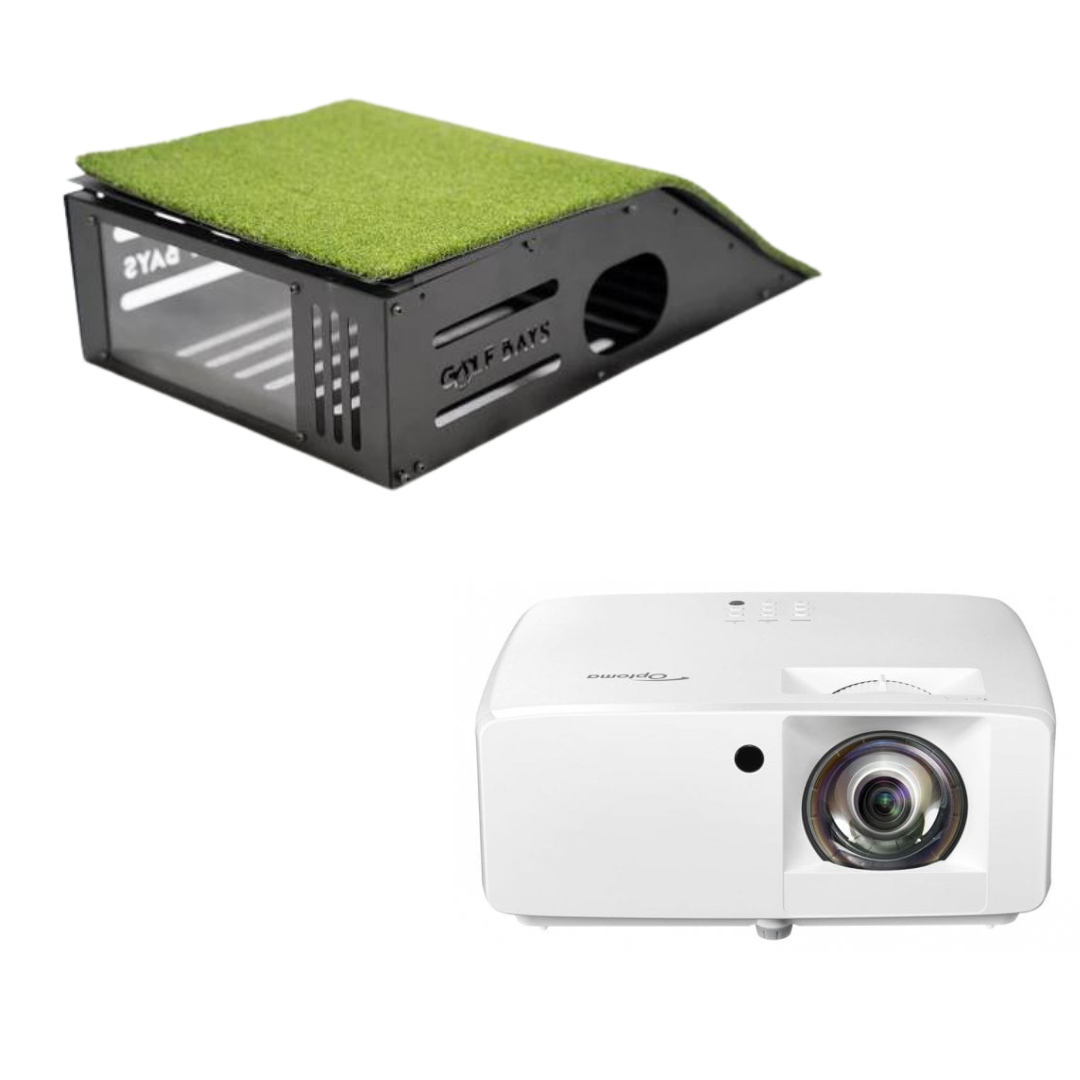
A projector finishes the job, and for a simulator the throw distance matters more than the resolution: a short throw projector sits close enough to the screen to stay out of your swing and your shadow.
How do you set up a launch monitor indoors?
Every maker gives exact distances in its manual, and it pays to follow them closely. The order is the same whichever unit you buy.
Mark the hitting spot. Put the ball where you'll hit from, centred on the screen, with the screen about 3m in front of it. Everything else is measured from this spot.
Place the unit. A camera unit goes across the ball from you, at the distance its maker sets. A radar unit goes on the target line behind the ball: 1.8m back for a Garmin R10, and about 3m for a Full Swing KIT. A ceiling unit is fixed once, above the hitting area.
Level it and aim it. Point the unit at the centre of the screen rather than the middle of the wall, and check it sits flat. A few degrees out and every shot starts off line.
Keep the sun off it. Direct sunlight through a window or a garage door can upset a camera unit, so set up out of it, or close the blind while you hit.
Check it with a club you know. Hit 10 shots with a club whose carry you know from the course and compare the average. If a 7-iron you carry 140 yards outdoors shows 160 in the garage, check the level, the aim and the balls before you blame the monitor.
GolfBays tip
If a left-hander shares the bay with a floor unit, mark both of its positions on the mat with tape. The unit goes back in exactly the same spot every time you swap, and you'll spend the evening hitting shots rather than lining it up.
Which launch monitor should you buy?
Match it to where you'll hit most of your shots.
A garage or spare room: the SkyTrak ST MAX, or the Square Golf if the budget stops at £700.
The range at weekends and the garage in winter: the FlightScope Mevo Gen 2, with 5m of depth indoors.
The range on a small budget: the Shot Scope LM1 for speed and distance, or the Garmin R10 if you want spin and courses too.
Camera data with no yearly fee: the Square Golf Omni.
A PC-based bay running GSPro: the Uneekor EYE MINI LITE.
A permanent room with a clear floor: Trackman iO Home, or the ProTee VX for half the price.
Launch monitor FAQs
Is the Garmin R10 or Rapsodo MLM2PRO better?
For indoor practice, the MLM2PRO: its 2 cameras and radar give you 13 metrics, and the Callaway RPT balls in the box give you its spin numbers. The R10 is £128 cheaper, runs for up to 10 hours on a charge and plays more than 43,000 courses with a Garmin Golf membership.
What's the best golf launch monitor for the money?
A FlightScope, if your room has 5m of depth: the Mevo Gen 2 at £1,199 or the older Mevo+ at £1,050, both with E6 Connect courses you keep. In a shorter room, the Square Golf at £689 gives you camera data from beside the ball for less.
Is there a cheaper alternative to Trackman?
Yes. For a ceiling unit, the ProTee VX is £6,240, about half the price of Trackman iO Home. For impact data from a floor unit, the Bushnell Launch Pro Indoor reads the ball with 3 cameras and infrared for £1,890.
Is SkyTrak as good as Trackman?
Not at the top end. Trackman iO measures 3D spin and spin axis from the ceiling and needs no set distance around the ball, for £12,594. The SkyTrak ST MAX gives a home bay the ball and club numbers most golfers use, from beside the ball, for £1,695.
Is SkyTrak or FlightScope better?
It depends on the room. The SkyTrak ST MAX sits beside the ball, so it suits a 4.5m garage, but its courses are a yearly membership after year 1. The FlightScope Mevo Gen 2 sits behind you and wants 5m of depth, and its 8 E6 Connect courses are yours to keep.
What launch monitors do professional golfers use?
Tour players mostly practise with Trackman, Foresight and Full Swing units. Tiger Woods uses the Full Swing KIT, and Foresight's GCQuad is a fixture of fitting studios, with the GC3 as its more portable sibling.
Do launch monitors work indoors?
Yes, but the type matters. Camera units beside the ball are at home indoors and need about 4.5m of depth. Radar units need 5m to 6.1m and the right balls for good spin numbers, and ceiling units like Trackman iO need no set distance at all.
Can left-handed golfers use a launch monitor?
Yes. A camera unit beside the ball moves to the other side of the mat, while a radar unit behind the ball stays where it is, because it sits on the target line. The ProTee VX, a ceiling unit built for right and left-handers, serves both without moving at all.
Are cheap launch monitors any good?
For learning your yardages, yes. The Garmin R10 at £421 tracks spin, club path and attack angle, and the Square Golf at £689 reads the ball and club with cameras. What you give up at the very bottom is spin: the £194.99 Shot Scope LM1 doesn't show it at all.
Do you need a PC to run a launch monitor?
Not always. The Garmin R50 runs on its own screen, and SkyTrak's app runs on Windows, macOS, iOS and Android. You do need a Windows PC for the Uneekor EYE MINI LITE, and for GSPro.
Find the launch monitor for your room
From handheld radars to ceiling-mounted Trackman, see every launch monitor we stock.
Shop launch monitors